


I bought a tart from Safeway for Easter at my mom’s brunch a few weeks ago. Just couldn’t bring myself to bake anything because, well… I am not a baker. I’m not really a “cooker” of anything. (Though I suspect people who actually cook don’t use the word cooker.) So. Safeway tart.
It was a hit. First thing to be finished. Probably should have bought two.
Hold that thought. The tart matters later.
Here’s where I actually am: doing too much. Again. And I’m guessing — since maybe I see your eye is twitching a bit— that you know this place. The season where every single thing on your calendar is good, wanted, even lucky… and your body is staging a quiet revolt anyway.
The body always files its complaint first. Mine files early and in triplicate, because living in a chronically ill body means the margin between “full life” and “flare” is thinner than anyone with a normal battery would guess.
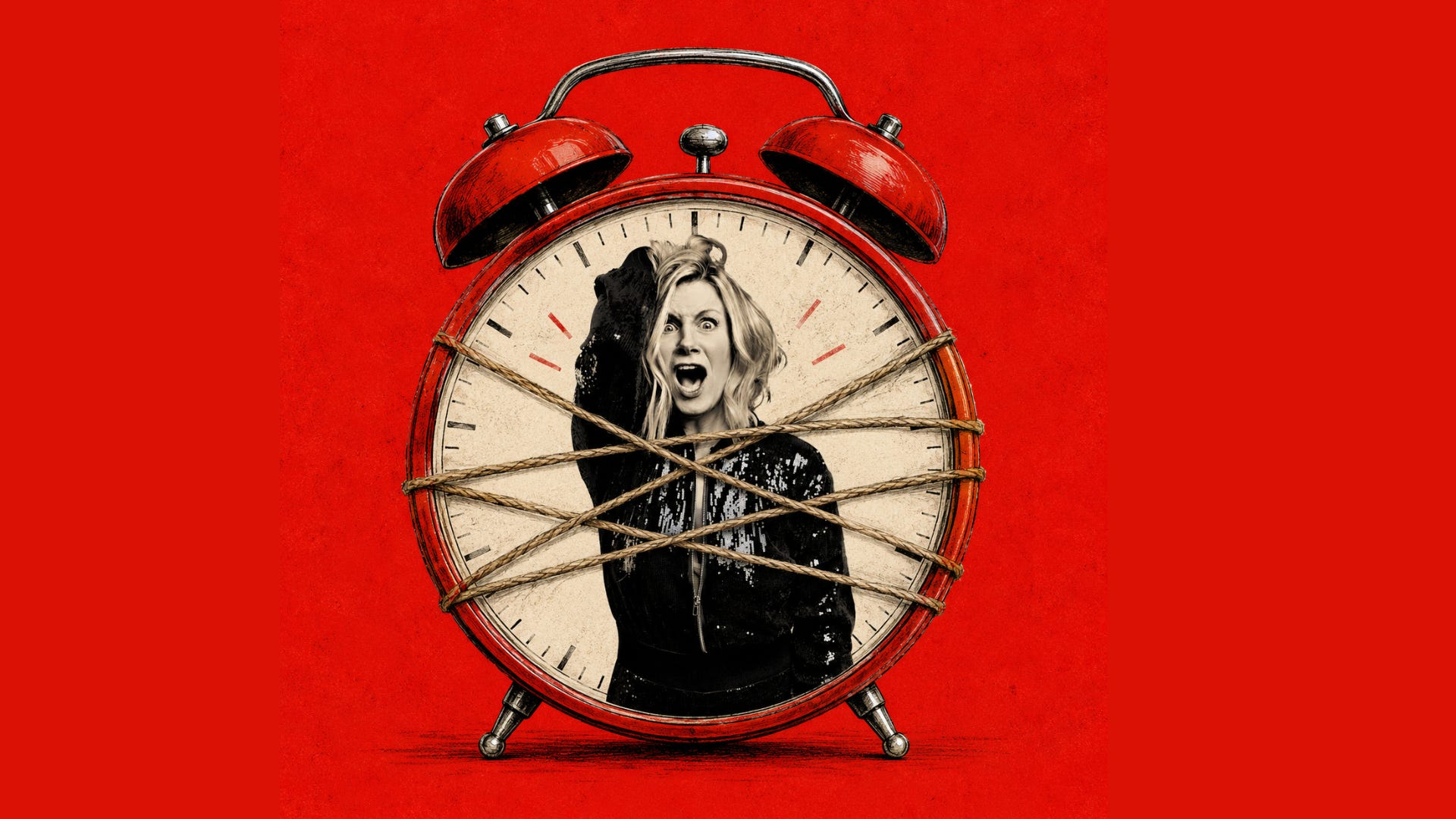
Here’s the trap, and once you see it you can’t unsee it: efficiency doesn’t empty your plate. It just upgrades you to a bigger plate.
Every hour I clear gets claimed by something new before the seat’s even cold. The demands expand to fill whatever space I create. I get more efficient and somehow end up more overwhelmed. Oliver Burkeman — one of my intellectual crushes — calls this the efficiency trap, and the crucial part is that it’s a trap with no exit on the level of doing. You cannot out-organize it. You cannot productivity-hack your way out of a hole that productivity is digging.
Don’t believe me? Here’s my current plate, which I earned by being disciplined and ambitious and putting myself out there — which is to say, by being efficient:
Two kids, one riddled with ADHD and the other away at his first year of college. Getting older, easier on my body, still a lot of work.
A new house being renovated simultaneously.
A late father-in-law’s estate I’m still clearing out, because he was, let’s call it, a hoarder-lite.
And seven shows a week for the next two months, while chronically ill, with no understudy. (Actually, I do have an understudy! But she’s 23 years old and I play a 50 year old mother of two with a drug addiction.)
These are, of course, great problems to have. A job. A house. A show. Some money. I know that. And one of my biggest pet peeves (even though I do it) is people performing their busyness like it’s a personality and also a competition. That’s not what this is.
This is me noticing that every item on that list arrived because I cleared space for it. The trap, working exactly as designed. The funny thing about the best things in a life is that they’re sometimes the exact same things making my left eye twitch and my right shoulder brace against the precariousness of everything.
When you’re chronically ill, the efficiency trap isn’t a time-management problem. It’s a symptom generator. I don’t pay for overdoing it in vague “stress.” I pay in flare days, in pain, in the currency of a body that keeps immaculate books and always collects. The trap is annoying for a well person. For the rest of us, it’s a health event on layaway.
So why can’t we just… stop?
Two reasons, one psychological and one almost spiritual.
The psychological one Burkeman calls the “nonchoice” choice: the compulsion to fill every hour feels like something happening to you, even though you are technically the one doing the scheduling. And it’s self-sealing — the more overwhelmed you are, the less equipped your brain is to find the exit. Chronic stress literally shrinks the part of the brain responsible for focus and decision-making. The trap disables the very tool you’d use to escape it.
We build things, create things, push through things, because the activity makes us feel like part of something larger than our own fragile bodies. The work becomes the proof that we existed. That we mattered.
And if you’re a creative person, this gets extra sticky — because the heroic project isn’t just a coping mechanism. It’s also, genuinely, the medicine. Seven shows a week is flattening my body. Seven shows a week is also the best mental health treatment I have ever found; I am more myself onstage, mid-story, mid-song, than anywhere else on earth. Creativity is both the medicine and the overdose, and the dosage line moves daily.
Which means the busyness isn’t a scheduling problem. It’s an existential strategy tangled up with the very thing that keeps us well. That’s why no app fixes it.
Here’s how you catch it in yourself. Ask, about any given commitment: did I choose this, or did it just fill the space? A chosen thing, even a hard one, has a quality of consent — you can locate the moment you said yes. A space-filler has no such moment. It simply appeared, the way water finds a hole. My stack, when I run this test honestly, is about half and half.
I don’t have the exit from the trap. What I have is a practice for the middle of it, and it’s almost insultingly small.
One slightly smaller breath.
Once a day, in the middle of the stack — between the show and the estate boxes, in the car line, wherever the bracing is happening — take one breath that is deliberately smaller than the situation seems to demand. Not a deep cleansing yoga breath. Not a reset. A smaller one. A breath that says: this moment does not require my whole nervous system.
Why it works: the trap runs on the feeling that everything is urgent and everything is yours to hold. The smaller breath is a ten-second dissent. It doesn’t shrink the plate. It briefly un-volunteers your body from the emergency.
If you live with chronic illness or pain, this matters so much. A body that reads everything as threat turns all its volume knobs up — pain louder, fatigue heavier, the twitch twitchier. A moment of genuine non-emergency, even ten seconds of it, is a signal in the other direction. The smaller breath is me telling my nervous system: this is not a crisis. This is a Tuesday.
And unlike every other intervention, it cannot be turned into another item on the list, because there is nothing to optimize. It’s too small to become a project. That’s the whole design.
The bigger question is still open, and I want to be honest about that. What I’m actually afraid of isn’t the middle of my life or even the end of it. It’s that all this pushing through now might be quietly shortening what comes later — and I don’t know what to do with that thought. I just know I can’t stop thinking it.
Is the right choice to live fully now, cost and all? Or to become so careful and nurturing toward myself that I never get any work done and also become insufferable at dinner parties?
I don’t know. That’s why I write — because writing is how I find out what I actually think, and sometimes I finish a piece and still don’t know. That has to be okay too.
Becker again: the irony of the human condition is that our deepest need is to be free of the anxiety of death — but it is life itself that awakens it.
I’m certainly not shrinking from life. That might be the whole problem.
So for now: I buy tarts from Safeway. I note that I probably should have bought two. And once a day, in the middle of it all, I take one slightly smaller breath.
It’s a very small plan. That’s exactly why it might work.

📖 Reading: I’m currently in the middle of Tell Me Where It Hurts by Rachel Zoffness. She’s a pain psychologist at UCSF and she uses a pain recipe metaphor that maps almost exactly onto how I think about my own high pain and low pain days. I’ll write more about this one soon. It’s the kind of book that makes you feel seen and slightly vindicated simultaneously. [Find it on Amazon here.]
🎧 Listening: Just finished a 10% Happier episode with Maria Semple, who wrote Where'd You Go, Bernadette. Loved it. If you haven't read the book, fix that immediately and then listen to this episode with Dan Harris.
📝 Substack Inspiration: Just discovered Jenna Park's Everything is Liminal, a visual newsletter with essays on culture, art, identity, and navigating the post-career creative life. Highly recommend. Free to anybody, but archived posts are paywalled.
More later, and thanks for reading/listening,
🙋♀️Molly
Substack runs on ♥️’s. Did you know that something like 99% of people never click it? So if this landed for you, be the 1%. Hit the heart. Share it with a human you like. Or subscribe and never miss a post. It genuinely helps more people find this little corner of the internet. I’ll be here either way.
If you liked this you might also like:


