


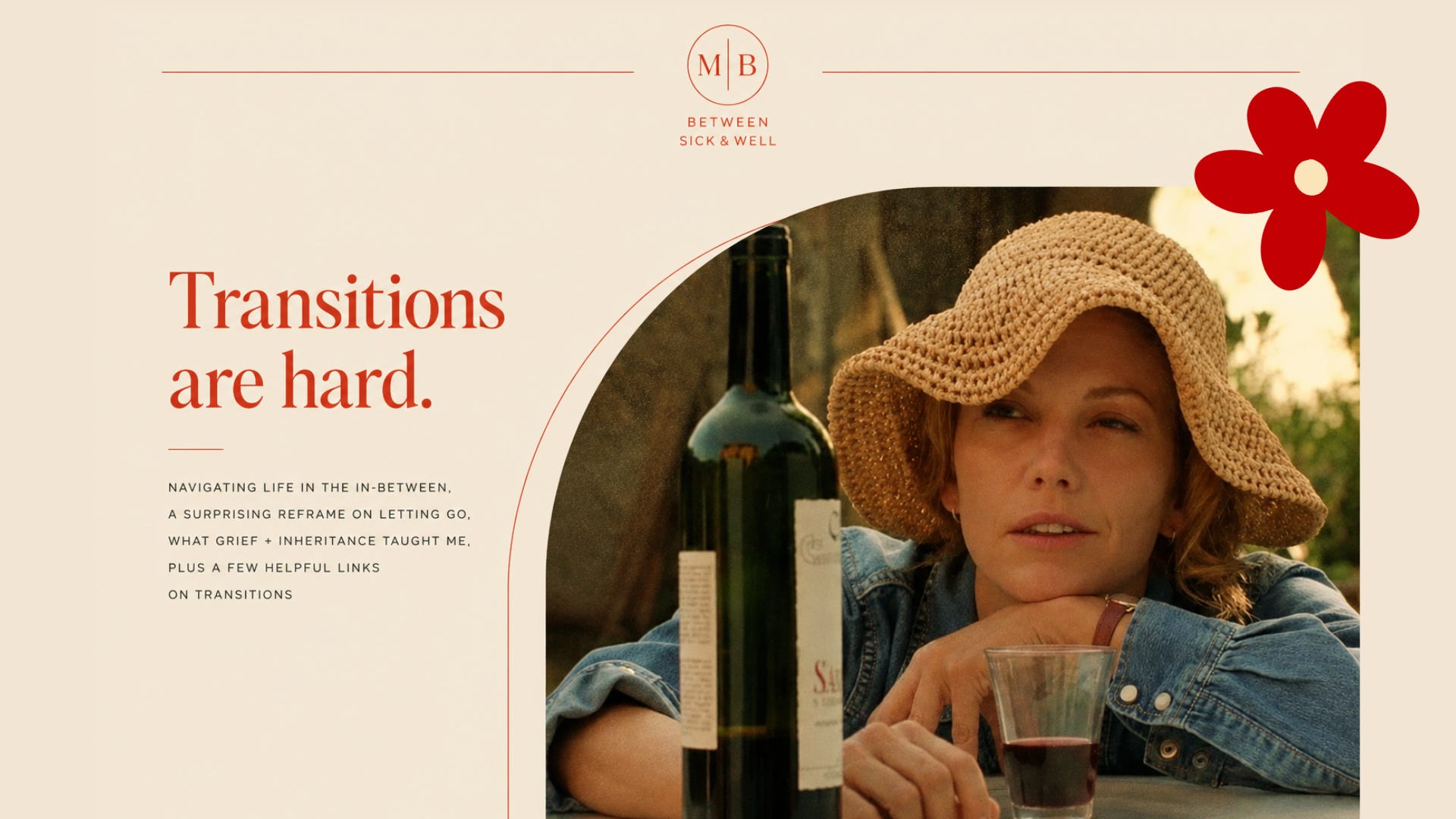
You’re in-between right now. Maybe between jobs, between homes, between the person you were and someone you can’t quite see yet. And if you’re anything like me, you hate it.
You want to skip ahead. You want the montage version, right? The part where the boxes are unpacked, the new title is on the door, the grief has gone away. Like a kid in the backseat you ask: are we there yet? Are we there yet?!
You might arrive in five minutes. You might arrive in five years. Nobody will tell you which.
And so you do the thing we all do. You grip. You push. You try to force the outcome into existence through sheer urgency, because urgency at least feels like progress.
I’ve had to learn the hard way, more than once: the in-between isn’t the obstacle between you and your life. The in-between IS your life. The murky, liminal, can’t-see-the-road part is where the actual becoming happens. Rushing through it isn’t efficiency. Rushing through it actually means you’re skipping the work.
I know. I hated hearing it too.
I’m speaking from the middle of a bouquet of transitions happening now.
A small one: I’ve stopped yoga and dance and started walking instead, because I’m a professional actor and I literally cannot help trying to be the star of pilates. (Look at me! Best yogi in the room!) So for now, I walk.
A medium one: after 25 years, I’m considering closing the door on coaching voice and performance. I can feel it’s a big one. I’m probably not arriving in five minutes.
And a large, life-altering one: my husband’s father died suddenly — pancreatic cancer, three weeks from diagnosis to gone — and out of nowhere we inherited an estate that changes things for us in real ways. But before that, my husband lost his job. Interviewed for a full year. No job. Turned fifty. No job. Watched his son graduate. No job. Finally got a job. Then his father died. And now we’re moving back to our hometown — the town where he played soccer and I performed in plays, where he left notes outside my window that my father found the next morning. The town of us.
I also know exactly what happens when I don’t let a transition unfold. I run quick. When a new idea hits, my urgency spikes, I start pushing the outcome, and before I know it I’m sliding into a hypomanic frenzy. Then I crash. Hard. Usually into illness. My body has enforced this lesson so many times that I’ve finally started taking notes.
So why does white-knuckling backfire?
Because what feels like determination is usually anxiety revving beneath the surface. Anxiety cannot tolerate not-knowing, so it manufactures motion — planning, pushing, forcing, checking — to create the sensation of certainty. But certainty is an illusion. There is no version of a real transition where you get to see the road ahead. So the gripping never actually delivers what it promises. It just burns your fuel. In my case, it burns it all the way down to the crash.
Letting go is not the opposite of effort. It’s the opposite of forcing. And here’s how you can tell which one you’re doing — a test you can run in about ten seconds:
Forcing has a jittery, clenched, are-we-there-yet quality. It’s loud. It needs the outcome now, and it gets angrier the longer the fog lasts.
Unfolding has a quieter signal. It still moves — you still pack the boxes, send the email, take the walk — but it can hold the not-knowing without panic.
If you check your grip and find your knuckles white: that’s not information about the transition. That’s information about your fear. Loosen the hand. The road doesn’t appear faster because you’re strangling the wheel.
Here’s the practice I use.
Once a day, for one week, write a single sentence: “Today I am between ______ and ______, and I don’t have to arrive yet.”
That’s it. Name the two shores. Then give yourself written permission to be in the water.
Let me try it for myself so you can see. This is a real one:
“Today I am between 25 years of coaching and the next phase of my creative life, and I don’t have to arrive yet.”
“Today I am between being needed daily by my kids and being their home base from a distance, and I don’t have to arrive yet.”
The first blank is easy. The second blank is the interesting one — some days you won’t be able to fill it in, and that’s the point. You’re training yourself to stay in the sentence, in the in-between, without lunging for the ending.
You’re signaling to your intuition that you trust it. And if you signal to your intuition that you trust it, it will take you home. Eventually.